

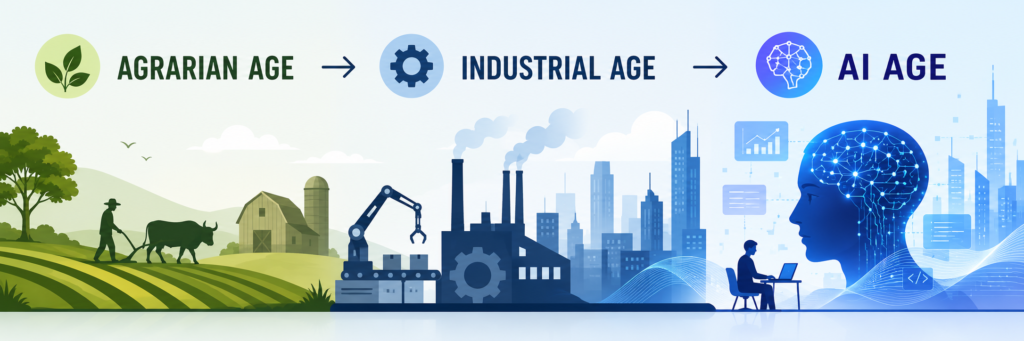
Human history has passed through different ages, each shaped by new technologies that transformed how people lived, worked, and created value.
Understanding these shifts helps us better understand the opportunities and challenges of our own generation.
1. The Agrarian Age
For most of human history, people worked close to the land. Farmers cultivated crops. Craftsmen produced goods with their hands. Merchants traded products in local markets. Families often operated their own farms, workshops, or small businesses. Economic life was largely centered around self-employment, agriculture, and craftsmanship. This period is often referred to as the Agrarian Age.2. The Industrial Age
The Industrial Revolution, which began in the late 1700s, dramatically changed society. Factories emerged. Machines increased production. Cities grew rapidly. As industries expanded, the need for a trained workforce also increased. Educational systems evolved to prepare people for industrial society by emphasizing punctuality, discipline, organization, literacy, and the ability to work within structured environments. Many historians point to the Prussian educational model as one influence on modern schooling systems. As a result, large numbers of people moved from self-employment into wage-based employment. The Industrial Age created unprecedented economic growth and improved living standards for millions, but it also shifted many people toward working within organizations rather than running their own enterprises.3. The AI Age
Today, we are witnessing another major transition. Artificial Intelligence is transforming how work is done. Tasks that once required entire teams can now be completed by individuals equipped with AI-powered tools. A single person can create content, analyze data, automate workflows, communicate with customers, and manage business operations at a scale that was previously unimaginable. In many ways, AI is returning power to the individual producer. One person with a laptop and the right tools can now accomplish what once required a department or even an entire company. Content can be generated faster. Research can be completed more efficiently. Customer interactions can be partially automated. Business processes can run around the clock. This does not eliminate the need for human creativity, wisdom, or oversight, but it significantly multiplies productivity.Learning from the Past
History shows a recurring pattern. When new technologies emerge, early adopters often gain significant advantages. The rise of real estate development created wealth opportunities for many investors in previous generations. The internet revolution created new industries and transformed global commerce in the 1990s. Today, Artificial Intelligence is creating another wave of opportunity. Those who learn and adapt may benefit greatly from the changes ahead.What AI Really Is
Despite the excitement surrounding AI, it is important to understand what it actually is. AI is not a conscious robot. It is not a human mind. It does not possess self-awareness. Artificial Intelligence is advanced software that uses mathematics, statistics, and large amounts of data to identify patterns, make predictions, and perform specific tasks. It simulates certain aspects of human intelligence, such as:- Learning from data
- Pattern recognition
- Problem solving
- Reasoning within defined parameters
- Self-correction and improvement